Manufacturing organizations rarely struggle because their people are unwilling to work hard.
In fact, one of the most revealing things I have observed throughout more than 30 years in manufacturing leadership is just how hard people will work to keep an unstable operation running.
Operators compensate for unreliable equipment.
Supervisors rearrange schedules around material shortages.
Maintenance technicians repeatedly repair the same failures.
Quality teams inspect defects out of the process.
Experienced employees rely on tribal knowledge to accomplish what the documented process cannot.
Leaders spend their days moving from one urgent problem to another.
And somehow, production continues.
That can look like resilience.
Sometimes it is.
But when heroic effort becomes the normal operating model, it can also hide something much more dangerous:
The manufacturing system is no longer controlling the work. The people are compensating for the system.
That distinction is fundamental to understanding sustainable operational excellence in manufacturing.
Operational Excellence is not achieved because an organization works harder, implements another Lean tool, adds another KPI, or launches another improvement initiative.
It is achieved when the operating system consistently enables people to produce the right product, through the right process, under conditions that protect safety, quality, and performance.
That requires something deeper than improvement activity.
It requires Operational Integrity.
Operational Excellence Is a System, Not a Program
Many organizations pursue Operational Excellence as a collection of initiatives.
Lean Manufacturing.
Six Sigma.
5S.
TPM.
OEE improvement.
Kaizen events.
Predictive maintenance.
Automation.
Digital transformation.
These methodologies and technologies can create tremendous value.
But none of them can compensate indefinitely for a manufacturing system whose fundamental relationships are misaligned.
A sophisticated dashboard cannot fix an unclear standard.
Automation cannot repair weak accountability.
More inspection cannot create quality upstream.
A Lean event cannot permanently eliminate a problem when the organizational conditions that created it remain unchanged.
And additional production pressure cannot transform an unstable process into a capable one.
This is why manufacturing leaders should think about Operational Excellence as an operating condition, rather than a program.
The question is not:
What improvement initiative are we running?
The better question is:
What conditions does our operating system create every day?
Manufacturing Plants Rarely Fail All at Once
Major operational failures receive attention.
Small deviations rarely do.
That is where risk begins.
A workaround solves today's problem.
An inspection catches today's defect.
An experienced technician gets the machine running again.
A supervisor finds enough material to finish the schedule.
Someone ignores a minor safety exposure because production needs to continue.
Nothing catastrophic happens.
So the organization moves forward.
Then it happens again.
Eventually, temporary responses become permanent behaviors.
The abnormal becomes familiar.
The familiar becomes accepted.
And the accepted condition becomes part of the operating culture.
I describe these conditions in Operational Integrity Code as Hidden Failure Nodes.
A Hidden Failure Node is not necessarily the failure itself. It is an underlying condition that repeatedly creates the opportunity for failure while remaining tolerated, compensated for, misunderstood, or inadequately controlled.
That changes how leaders should approach root cause analysis and continuous improvement.
Instead of asking only:
“What went wrong?”
Ask:
“What condition within our system made this outcome possible—and what has allowed that condition to remain?”
That is a much more powerful question.
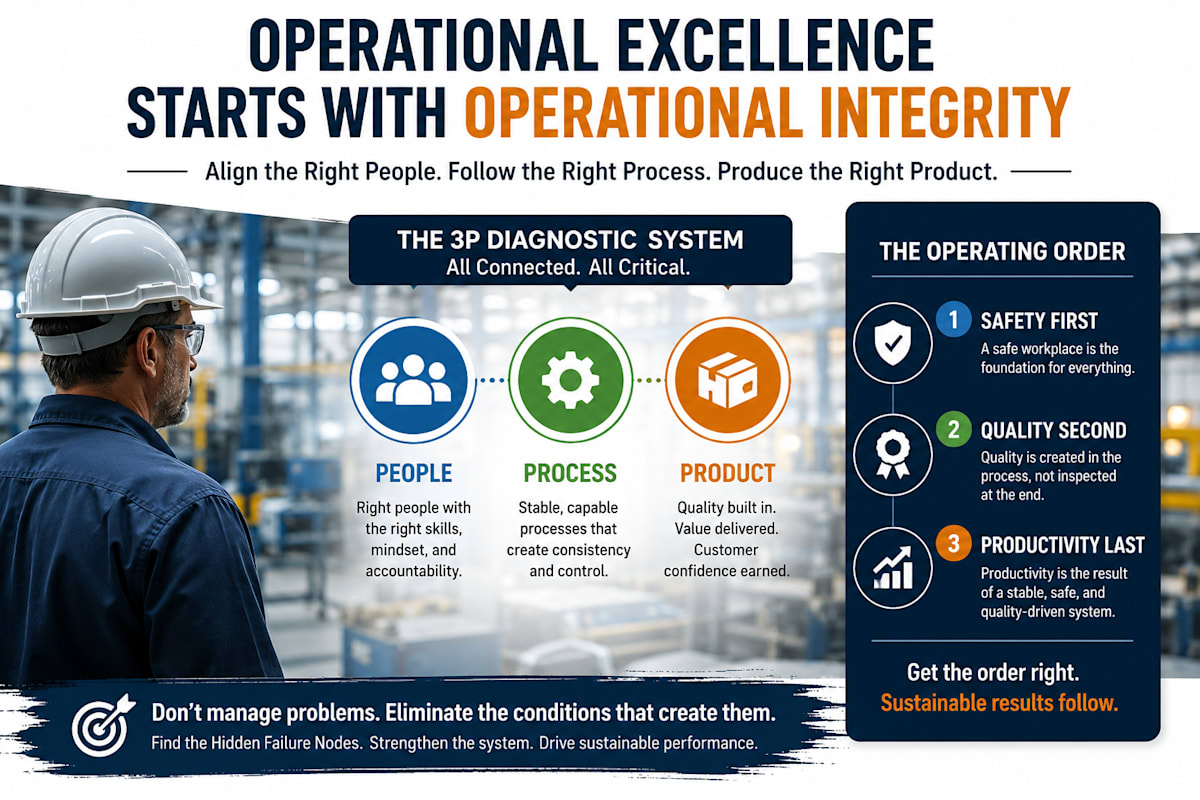
The 3P Diagnostic System: People, Process, Product
One of the central frameworks in Operational Integrity Code is the 3P Diagnostic System:
People. Process. Product.
Manufacturing problems often become difficult to solve because organizations separate these elements.
Production owns output.
Quality owns defects.
Maintenance owns equipment.
Engineering owns technical changes.
Safety owns incidents.
Human Resources owns people issues.
Supply Chain owns materials.
Those responsibilities may be organizationally necessary, but the actual manufacturing system does not operate inside departmental boundaries.
Everything intersects.
A product defect may appear to be an operator problem until leaders discover that the work instruction is ambiguous.
Repeated downtime may appear to be a maintenance problem until the team discovers that the production method is accelerating equipment wear.
A missed shipment may appear to be a scheduling problem until leaders uncover unstable quality, excessive rework, material shortages, and unreliable equipment underneath it.
The visible symptom tells you where the problem appeared.
It does not necessarily tell you where the problem originated.
That is why leaders must diagnose People, Process, and Product together.
People: The Right People Need the Right Conditions
I have written before that people are not automatically an organization's greatest asset.
The right people are.
But there is another side to that principle.
Even the right people cannot sustainably overcome the wrong system.
Good employees placed inside unstable processes eventually become frustrated.
Highly capable operators cannot consistently produce quality from processes that are incapable of holding requirements.
Strong supervisors cannot effectively lead if every hour is consumed by firefighting.
Talented maintenance teams cannot create reliability when preventive maintenance is continuously sacrificed for production.
The goal of manufacturing leadership is therefore not simply to hire talented people.
It is to create an operating environment where capable, accountable people can succeed without constantly fighting the system.
That means establishing clear expectations, executable standards, effective training, appropriate authority, meaningful accountability, and opportunities to identify problems without being punished for exposing reality.
Process: Standard Work Must Reflect Actual Work
A documented process is not necessarily a controlled process.
Walk onto almost any manufacturing floor and ask enough questions and you may eventually hear:
"That's what the procedure says, but this is how we actually have to do it."
Leaders should pay attention when they hear that sentence.
It may indicate poor discipline.
But it may also reveal something far more valuable:
The documented process and operational reality have separated.
Perhaps equipment condition changed.
Maybe the product mix evolved.
Maybe material characteristics shifted.
Perhaps takt time no longer supports the required work sequence.
Maybe an inspection requirement cannot realistically be completed within cycle time.
Or perhaps employees developed a workaround years ago and nobody ever corrected the underlying condition.
Standard work must establish control, but standards also have to survive contact with reality.
A process that cannot consistently be executed as designed is not stable simply because the procedure has been approved.
Product: Quality Must Be Created, Not Inspected Into Existence
One of the most expensive misconceptions in manufacturing is believing that inspection creates quality.
It does not.
Inspection detects whether quality was created earlier.
By the time a defect reaches final inspection, the organization has already consumed labor, equipment capacity, material, energy, floor space, and time producing something incorrectly.
The further a defect travels downstream, the more expensive it becomes.
Sustainable manufacturing quality improvement therefore requires moving control closer to the point where variation originates.
Can the operator recognize abnormal conditions?
Are critical characteristics understood?
Is the process capable of meeting product requirements?
Can variation be detected before additional value is added?
Are engineering changes effectively translated into production controls?
Does feedback return upstream quickly enough to prevent recurrence?
Quality should not be something the organization discovers at the end.
It should be something the process creates from the beginning.
Safety First. Quality Second. Productivity Last.
This principle often generates discussion because manufacturing organizations naturally focus heavily on productivity.
Productivity matters enormously.
But sustainable productivity cannot be built by sacrificing the conditions that make production possible.
The operating order I advocate is:
Safety First.
Quality Second.
Productivity Last.
“Last” does not mean unimportant.
It means productivity should be the result of a stable operating system, not the price employees pay for an unstable one.
Consider a plant that achieves its production target while simultaneously increasing:
- safety exposure,
- employee fatigue,
- overtime,
- scrap,
- rework,
- deferred maintenance,
- equipment deterioration,
- quality escapes,
- turnover.
Did productivity really improve?
Or did the organization borrow performance from tomorrow?
I call this borrowed performance.
Eventually, the bill arrives.
It arrives as downtime, injuries, defects, turnover, equipment failures, customer complaints, missed schedules, or lost capacity.
True productivity comes from removing the conditions that force the organization to compensate.
Stop Rewarding Heroics and Start Building Capability
Manufacturing culture often celebrates the person who saves the day.
Sometimes that recognition is deserved.
But leadership should also ask why the day continually needs saving.
If one maintenance technician is the only person capable of repairing a critical machine, that technician is valuable—but the system is vulnerable.
If one scheduler holds the entire production plan together through personal knowledge, the organization has dependency rather than capability.
If one quality engineer understands a recurring defect better than anyone else, the company needs to convert that knowledge into process control.
Knowledge that remains trapped inside individuals is difficult to scale and impossible to guarantee.
Operational Excellence requires transferring knowledge into:
training,
standard work,
process controls,
maintenance strategies,
visual systems,
escalation routines,
cross-functional communication,
and organizational capability.
The goal is not to make experienced people less valuable.
It is to make their knowledge more valuable by embedding what they know into the system.
Accountability Without Blame
Operational Excellence also requires accountability.
But accountability and blame are not interchangeable.
When something goes wrong, asking “Who did it?” may identify the final person who interacted with the failure.
It may not explain why the failure was possible.
A stronger leader asks both individual and systemic questions.
Was the standard clear?
Was the employee trained?
Was the equipment capable?
Were the correct materials available?
Was production pressure influencing behavior?
Had the problem happened previously?
Were earlier warnings ignored?
Was the employee authorized to stop the process?
Was a known workaround already considered normal?
Then accountability can be applied intelligently.
People should be accountable for choices within their control.
Leadership should be accountable for the conditions the organization creates and tolerates.
That balance strengthens both Integrity and Accountability.
Sustainable Continuous Improvement Starts With Seeing Reality
Operational Excellence cannot be managed entirely from conference rooms.
Dashboards matter.
KPIs matter.
Data matters.
But data should tell leaders where to look, not eliminate the need to look.
Go to the process.
Observe the work.
Talk to the people performing it.
Watch what happens during startup, changeovers, disruptions, material shortages, equipment failures, and shift transitions.
Look for the moments where the documented system and actual behavior separate.
Those gaps often contain the greatest opportunities for improvement.
After more than three decades in manufacturing, I have become convinced that one of leadership's most important responsibilities is refusing to normalize what should be corrected.
The moment a leader decides not to walk past a problem is the moment the system begins to change.
From Operational Excellence to Operational Integrity
The objective is not perfection.
Manufacturing will always contain variation, unexpected events, equipment failures, human mistakes, supply disruptions, and competing priorities.
Operational Integrity is about building a system capable of recognizing those abnormalities, responding intelligently, learning from them, and preventing temporary deviations from becoming permanent operating conditions.
That requires alignment.
The Right People.
Following the Right Process.
Producing the Right Product.
Safely. With quality. Consistently.
That is the foundation of sustainable Operational Excellence.
And perhaps the most important question manufacturing leaders can ask is not:
“How do we get our people to work harder?”
It is:
“What does our system keep asking good people to compensate for—and why haven't we fixed it yet?”
The answer may reveal where your next meaningful improvement should begin.
About Chris Clevenger
Chris Clevenger is a manufacturing operations leader and author with more than 30 years of experience in manufacturing leadership, plant operations, Operational Excellence, Lean Manufacturing, Continuous Improvement, Safety, Quality, Productivity, organizational transformation, and team development.
He is the author of:
- and -
Operational Integrity in Action: A Plant Turnaround Story Using the 3P Diagnostic System.
His work focuses on helping manufacturing leaders identify Hidden Failure Nodes, strengthen the connection between People, Process, and Product, and build operating systems where sustainable performance is achieved by design rather than heroics.