


Chris Clevenger
Chris Clevenger is a manufacturing operations leader, turnaround executive, author, and creator of the Operational Integrity Series, a growing body of work focused on helping manufacturing leaders identify hidden operational failure, restore stability, and build stronger systems around People, Process, and Product.
With more than three decades of hands-on experience in manufacturing leadership, plant management, operational excellence, quality, production, materials management, safety, Lean Manufacturing, and industrial operations, Chris built his career from the shop floor upward.
He began working directly inside manufacturing operations and advanced through machining, quality control, production control, materials management, plant leadership, and executive operations roles. That career gave him something that could not be learned from theory alone: a front-row view of how manufacturing systems actually perform under pressure.
Chris has led complex manufacturing environments involving CNC and manual machining, welding, metal fabrication, forming, industrial assembly, quality management, supply chain, maintenance, and production operations. He has carried full P&L responsibility for manufacturing businesses generating tens of millions of dollars in annual revenue, managed large plant inventories, overseen organizations of more than 150 employees, and worked with Lean Manufacturing, Lean Six Sigma, Total Quality Management, ISO/API quality systems, and other continuous improvement methods.
But the ideas behind the Operational Integrity Series did not begin as a plan to become an author.
They began as notes.
Over the course of Chris’s manufacturing career, he accumulated years of leadership notes, training material, operating principles, talking points, observations, problem-solving methods, and lessons learned from working inside real plants. Much of it had been created for his own use or to help develop employees, supervisors, managers, and leadership teams.
The material existed, but it was never organized as something that could simply be handed to another manufacturing leader and put to work.
That changed during Chris’s recovery from brain surgery.
While recovering, he began taking those decades of scattered notes and formally documenting them. The original goal was simply to preserve the knowledge in a more organized, useful form.
As the material grew, Chris realized he was not just organizing notes.
He was uncovering a system.
Again and again throughout his career, he had seen manufacturing operations struggle with the same basic pattern: good people working hard inside systems that continued producing recurring safety problems, quality failures, rework, schedule disruption, poor labor utilization, low morale, and operational firefighting.
Organizations often responded with more training, more meetings, more inspection, more supervision, or more pressure.
The problem would improve temporarily.
Then it would return.
Chris came to believe the real question was not simply:
“How do we fix this problem?”
It was:
“What condition inside the system allows this problem to keep happening?”
That question became the foundation of Operational Integrity Code.
From Decades of Manufacturing Experience to the 3P Diagnostic System
As Chris organized the lessons gathered throughout his career, several ideas began connecting into a common operating structure.
At the center was the relationship between:
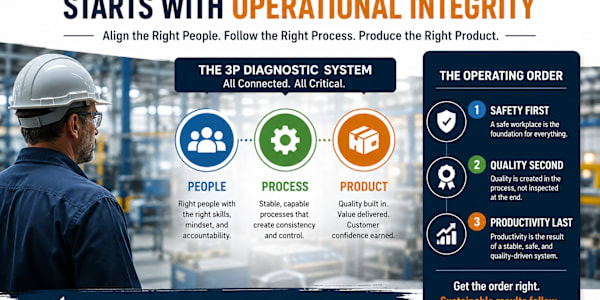
People → Process → Product
People execute and adapt to the process.
Processes shape product outcomes.
Products provide physical evidence of what is really happening upstream.
When those three areas become disconnected, organizations begin experiencing recurring instability.
Chris developed the 3P Diagnostic System to help manufacturing leaders examine those relationships together rather than treating every problem as an isolated event.
From that work came the concepts of Hidden Failure Nodes, the Reality Filter, Structural Recode, and the Operational Integrity Interface (OII).
Hidden Failure Nodes describe the small structural weaknesses that become embedded in normal manufacturing work—unclear handoffs, workarounds, unstable standards, tribal knowledge, repeated rework, decision bottlenecks, normalized safety exposure, inspection dependence, and other conditions that allow failure to repeat.
The Reality Filter describes how organizations gradually learn to explain those recurring problems instead of diagnosing the structure producing them.
The Operational Integrity Interface provides a disciplined way to detect those failure nodes, understand how people are adapting to them, correct the underlying process structure, align People, Process, and Product, and build systems capable of holding the improvement over time.
Those ideas became Operational Integrity Code: The 3P Diagnostic System for Eliminating Hidden Failure and Restoring Safety, Quality, and Productivity in Manufacturing.
The book was created for people responsible for real manufacturing operations—plant managers, operations executives, production managers, supervisors, quality professionals, safety leaders, maintenance teams, engineers, continuous improvement professionals, and manufacturing leaders responsible for turning performance expectations into daily operational reality.
Its central principle is clear:
Safety First → Quality Second → Productivity Last
Chris’s position is that sustainable manufacturing productivity cannot be built by sacrificing safety or quality to protect output. Safety creates the foundation. Quality stabilizes the work. Productivity becomes sustainable when the operating system is capable of supporting it.
The Story Became a Second Book
While writing Operational Integrity Code, another question kept returning:
How do I show what this actually looks like inside a manufacturing plant?
A diagnostic framework can be understood intellectually and still be difficult to apply when a leader is standing inside a plant dealing with machine downtime, missed schedules, quality escapes, rework, frustrated employees, competing departmental priorities, safety pressure, and customers waiting for product.
Chris wanted readers to see the principles operating under those conditions.
That idea became Operational Integrity in Action: A Plant Turnaround Story Using the 3P Diagnostic System.
Rather than writing another technical manufacturing leadership book, Chris created the fictional Ridgeway Trailer Manufacturing and placed the reader alongside newly appointed Plant Manager Daniel Mercer.
Ridgeway and its characters are fictional.
The operational conditions are drawn from problems familiar across real manufacturing environments.
Daniel enters a plant where safety exposure has become routine, defects are discovered too late, rework is accepted as part of the job, production schedules constantly change, departments blame one another, experienced employees compensate for unstable processes, and morale has fallen because people no longer believe the system can become stable.
As Daniel begins applying the principles of Operational Integrity Code, the reader watches the transformation develop from the shop floor outward.
He observes.
He asks questions.
He conducts Gemba walks.
He listens to operators and leaders.
He challenges familiar explanations.
He identifies Hidden Failure Nodes.
And most importantly, he begins changing the structure responsible for producing the same failures over and over again.
The story demonstrates the central idea behind the series: operational stability does not come from asking people to work harder. It comes from correcting the system so people no longer have to compensate constantly for its weaknesses.
The Operational Integrity Series
What began as an effort to organize more than three decades of manufacturing knowledge grew into the Operational Integrity Series.
The series is built around a simple but demanding belief:
Manufacturing stability is designed.
Recurring safety incidents, quality problems, downtime, rework, schedule failure, low morale, labor inefficiency, and productivity loss should not automatically be accepted as unrelated problems or unavoidable parts of manufacturing.
When the same condition repeatedly returns, it is evidence.
The responsibility of leadership is to find the mechanism allowing it to return and correct the structure that supports it.
Through Operational Integrity Code and Operational Integrity in Action, Chris connects manufacturing leadership theory with plant-floor execution. One book establishes the diagnostic architecture. The other puts that architecture into motion through a manufacturing turnaround story.
Together, they address subjects central to modern manufacturing leadership and operational excellence, including plant turnaround, manufacturing productivity, process improvement, safety culture, quality management, leadership accountability, workforce development, Lean Manufacturing, continuous improvement, root cause thinking, manufacturing culture, process stability, and sustainable operational performance.
Chris continues working directly inside manufacturing operations, where the principles behind the Operational Integrity Series remain connected to the realities of the plant floor rather than separated from them.
The books may have started with decades of handwritten notes, training material, early mornings, and an unexpected period of recovery.
But they developed into something larger:
A system for helping manufacturing leaders see what their operation is actually telling them.
Because once recurring failure can be seen clearly, it can be diagnosed.
Once it can be diagnosed, the structure can be changed.
And when the structure changes, the operation has the opportunity to change with it.
here.
Chris Clevenger is a manufacturing operations leader, turnaround executive, author, and creator of the Operational Integrity Series, a growing body of work focused on helping manufacturing leaders identify hidden operational failure, restore stability, and build stronger systems around People, Process, and Product.
With more than three decades of hands-on experience in manufacturing leadership, plant management, operational excellence, quality,...
Books
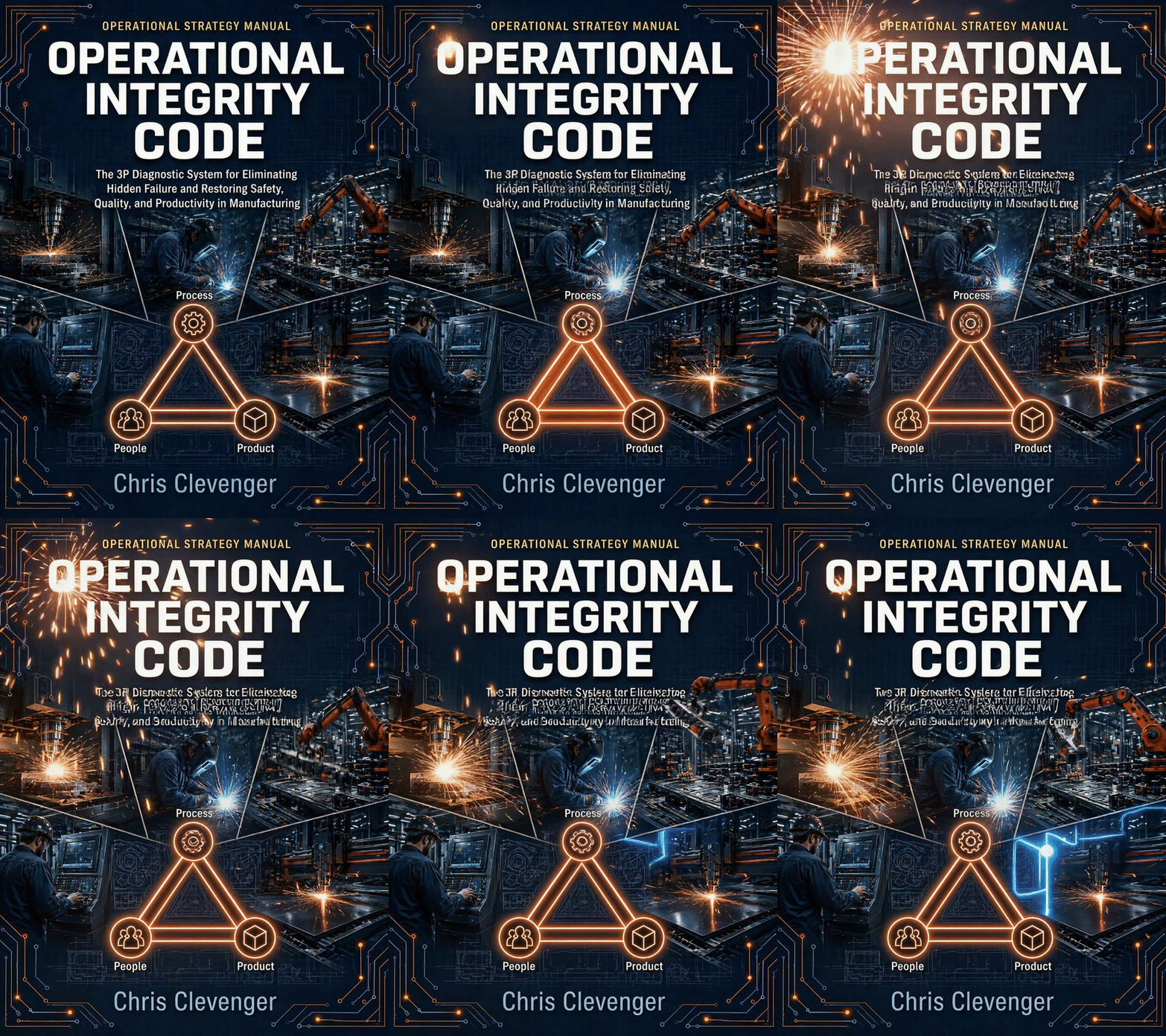
Operational Integrity Code
The 3P Diagnostic System for Eliminating Hidden Failure and Restoring Safety, Quality, and Productivity in Manufacturing
From the series:
Operational Integrity Series
Operational Integrity Code: The 3P Diagnostic System for Eliminating Hidden Failure and Restoring Safety, Quality, and Productivity in Manufacturing is a practical manufacturing leadership and operational excellence book designed for plant managers, operations leaders, manufacturing executives, quality professionals, safety leaders, engineers,...
Read moreor
Learn More
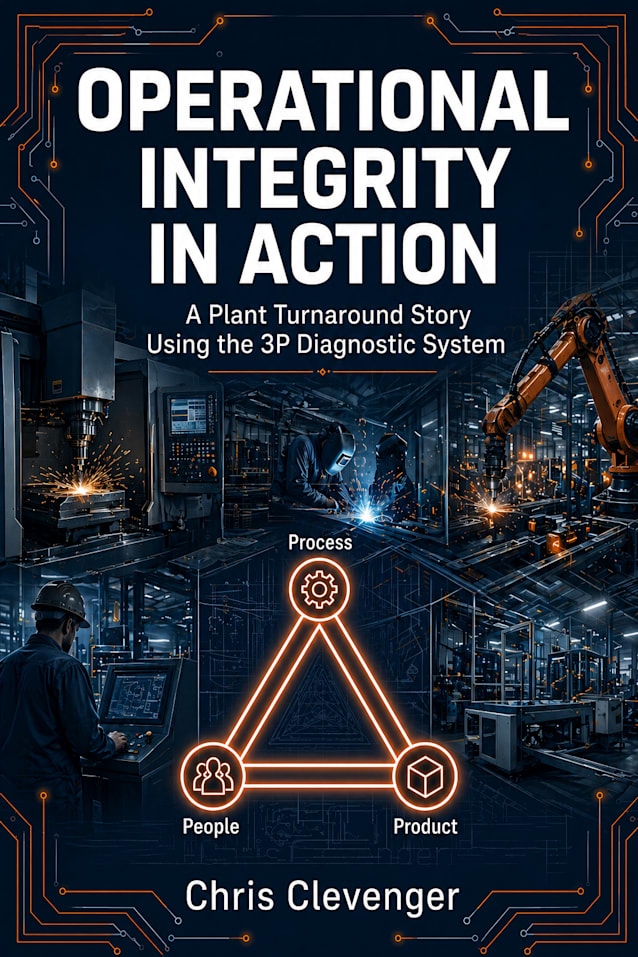
Operational Integrity in Action
A Plant Turnaround Story Using the 3P Diagnostic System
From the series:
Operational Integrity Series
Operational Integrity in Action: A Plant Turnaround Story Using the 3P Diagnostic System brings manufacturing leadership, operational excellence, and plant turnaround strategy to life through a realistic story set inside a struggling industrial operation.
Ridgeway Trailer Manufacturing is busy—but it is not stable.
Safety risks have become...
Read moreor
Learn More
Series
Operational Integrity Series
The Operational Integrity Series is a manufacturing leadership and operational excellence book series focused on helping plant leaders identify the hidden structural conditions that create recurring problems in safety, quality, productivity, morale, reliability, and...
Blog
Read a Sample of My Book!
Join my mailing list to receive a free sample of Operational Integrity Code