Operational Integrity Series
The Operational Integrity Series is a manufacturing leadership and operational excellence book series focused on helping plant leaders identify the hidden structural conditions that create recurring problems in safety, quality, productivity, morale, reliability, and manufacturing performance.
Created from more than three decades of real-world manufacturing leadership experience, the series introduces the Operational Integrity Code, the 3P Diagnostic System, the Operational Integrity Interface (OII), Hidden Failure Nodes, the Reality Filter, and Structural Recode. Together, these concepts provide a practical system for understanding why manufacturing problems repeat—and how leaders can correct the conditions that allow those problems to keep returning.
At the center of the series is the 3P framework: People → Process → Product.
Manufacturing problems are often treated as separate issues: an operator problem, a maintenance problem, a quality problem, a scheduling problem, or a productivity problem. The Operational Integrity Series challenges that approach. It shows how recurring operational instability often develops at the connections between People, Process, and Product.
Employees compensate for broken processes. Processes distort product outcomes. Product defects expose instability upstream. Rework becomes routine. Safety shortcuts become accepted. Schedules become unreliable. Inspection replaces prevention. Experienced employees become responsible for holding unstable systems together.
Over time, these conditions can become so familiar that the organization stops recognizing them as failures.
These are Hidden Failure Nodes.
The Operational Integrity Series is designed to help plant managers, operations managers, manufacturing executives, production leaders, quality professionals, safety leaders, maintenance teams, engineers, supervisors, and continuous improvement professionals find these hidden conditions before they become larger failures.
The series follows a clear operational principle:
Safety First → Quality Second → Productivity Last
Sustainable manufacturing productivity cannot be created by pressure alone. A plant must first establish safe operating conditions and reliable quality. Productivity then becomes the result of a stable manufacturing system rather than an outcome dependent on overtime, firefighting, workarounds, additional inspection, or heroic individual effort.
Book One: Operational Integrity Code
Operational Integrity Code: The 3P Diagnostic System for Eliminating Hidden Failure and Restoring Safety, Quality, and Productivity in Manufacturing establishes the doctrine and diagnostic structure behind the series.
It teaches leaders how to recognize Hidden Failure Nodes, challenge the organization's Reality Filter, diagnose instability across People, Process, and Product, and use the Operational Integrity Interface (OII) to move from failure detection through structural diagnosis, Structural Recode, operational integration, and long-term system stability.
Rather than asking only, “How do we fix this problem?” Operational Integrity Code pushes leaders toward a more important question:
“What condition inside the system allows this problem to keep happening?”
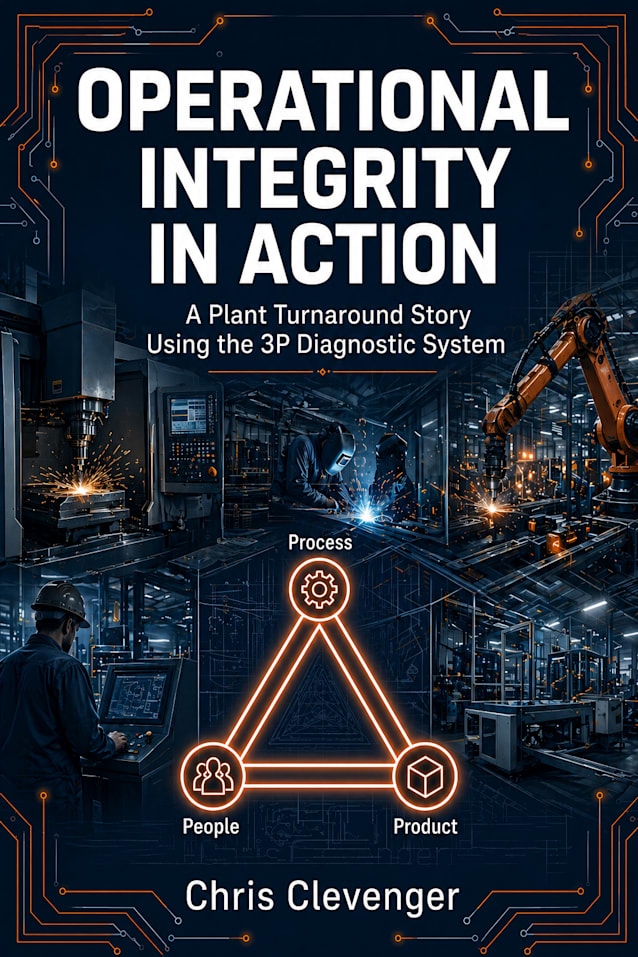
Book Two: Operational Integrity in Action
Operational Integrity in Action: A Plant Turnaround Story Using the 3P Diagnostic System takes those same manufacturing leadership principles onto the plant floor.
Through the fictional Ridgeway Trailer Manufacturing operation, Plant Manager Daniel Mercer enters a struggling manufacturing facility dealing with recurring safety exposure, poor quality, rework, unreliable scheduling, low labor utilization, weak morale, department conflict, and constant operational firefighting.
The plant and characters are fictional. The manufacturing conditions are not.
Readers see the 3P Diagnostic System applied as Daniel moves from observation to diagnosis, identifies Hidden Failure Nodes, challenges accepted explanations, stabilizes People, Process, and Product, and begins rebuilding the operation around a permanent standard of Operational Integrity.
Together, the books bridge the gap between manufacturing leadership theory and real plant execution.
The Operational Integrity Series is not built around productivity hacks, motivational slogans, or temporary improvement campaigns. It is about understanding the architecture behind operational performance and building manufacturing systems that remain stable across shifts, employees, production pressure, staffing changes, equipment challenges, and changing business conditions.
For leaders responsible for manufacturing operations, plant turnarounds, operational excellence, Lean manufacturing, continuous improvement, safety performance, quality management, productivity improvement, workforce accountability, process stability, and manufacturing culture, the Operational Integrity Series provides a different way to see recurring failure—and a structured way to remove it.
Because manufacturing stability is never accidental. It is designed.
Operational Integrity Code