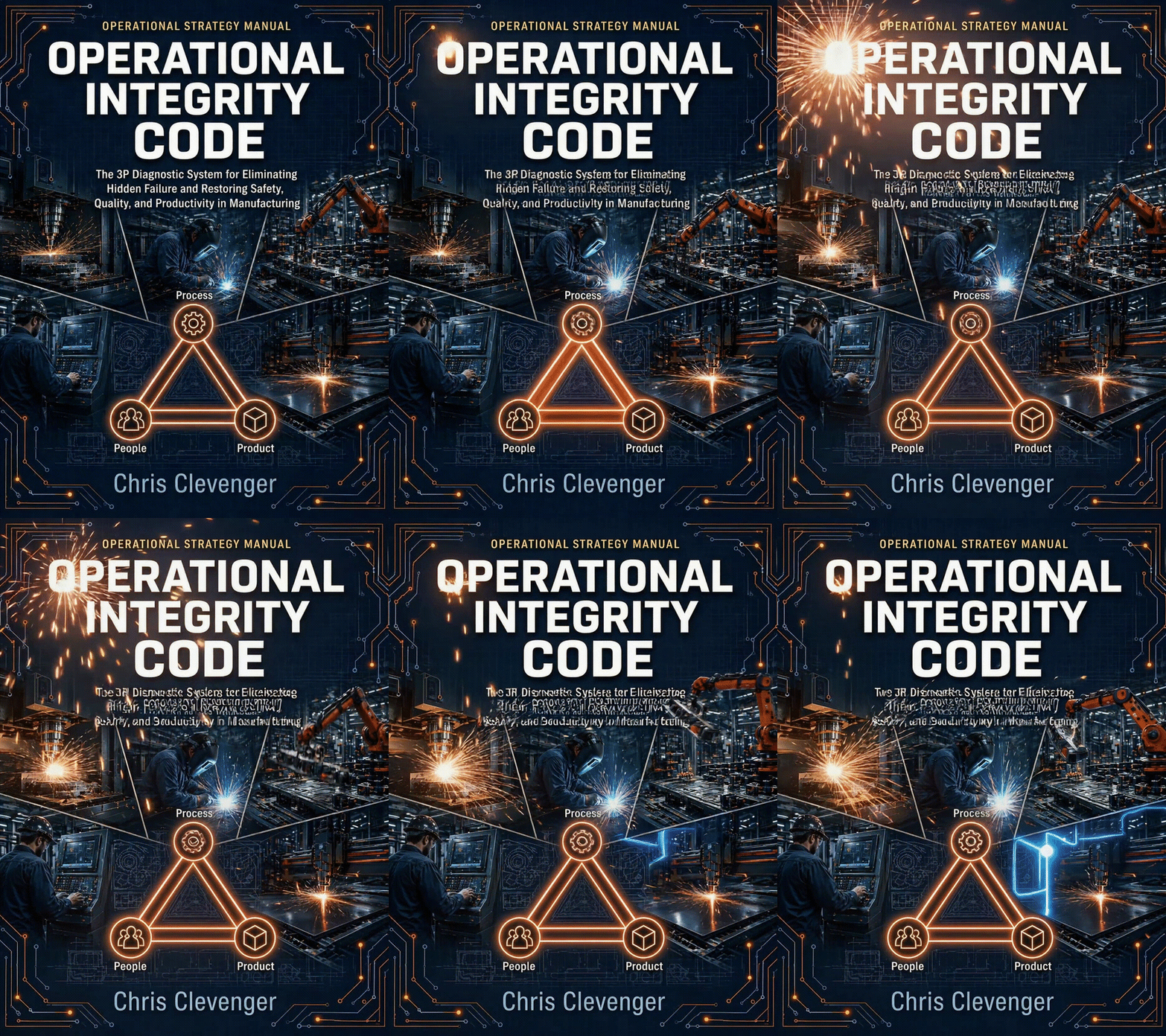
Operational Integrity Code
About
Operational Integrity Code: The 3P Diagnostic System for Eliminating Hidden Failure and Restoring Safety, Quality, and Productivity in Manufacturing is a practical manufacturing leadership and operational excellence book designed for plant managers, operations leaders, manufacturing executives, quality professionals, safety leaders, engineers, supervisors, and continuous improvement teams responsible for real plant performance.
Manufacturing systems rarely fail all at once.
They drift.
A shortcut becomes acceptable. A quality check gets rushed. Rework becomes normal. Experienced employees compensate for weak processes. Safety risks are tolerated because nothing has happened yet. Production schedules change constantly. Departments begin protecting their own priorities. Everyone stays busy, but the operation becomes less stable.
Operational Integrity Code was written to help manufacturing leaders recognize those conditions before they become larger failures.
At the center of the book is the 3P Diagnostic System: People → Process → Product.
The 3P Diagnostic System helps leaders examine manufacturing problems as connected system conditions rather than isolated events. A defect may appear to be a quality problem. Downtime may appear to be a maintenance problem. A missed shipment may appear to be a scheduling problem. An unsafe act may appear to be an employee problem.
But recurring operational problems often point to something deeper.
The book calls these conditions Hidden Failure Nodes.
Hidden Failure Nodes are small structural weaknesses embedded inside normal work that allow instability to repeat. They can appear as unclear handoffs, unworkable procedures, undocumented adjustments, tribal knowledge, recurring rework, inspection dependence, schedule disruption, unsafe workarounds, decision bottlenecks, or processes that only perform well when the most experienced employees are present.
Once these conditions become familiar, organizations often begin explaining them instead of correcting them.
That is where the Reality Filter becomes important.
The Reality Filter describes how organizations learn to interpret recurring instability through familiar explanations such as:
“Operator issue.”
“Training issue.”
“Maintenance issue.”
“Supplier issue.”
“Scheduling problem.”
“Just part of manufacturing.”
Those explanations may contain part of the truth, but they do not always identify the system that allows the same problem to keep returning.
Operational Integrity Code shifts the leadership question from:
“Why did this happen?”
to:
“What condition inside the system allows this to keep happening?”
That shift moves manufacturing leadership away from symptom management and toward structural diagnosis.
The book introduces the Operational Integrity Interface (OII), a five-phase diagnostic system designed to help leaders move from recurring operational instability to long-term manufacturing stability.
The OII guides leaders through:
Failure Node Detection — identifying where problems repeatedly appear.
Human Mechanics Analysis — understanding how employees are adapting to unstable systems.
Structural Process Recode — changing the process conditions that are producing recurring failure.
Integrated Operational Rebuild — aligning People, Process, and Product into one operating system.
System-Level Implementation — building the standards and leadership routines needed to prevent the operation from drifting back into old habits.
Throughout the book, the focus remains on a clear manufacturing leadership principle:
Safety First → Quality Second → Productivity Last
Operational Integrity Code challenges the idea that productivity should be pursued independently from safety and quality.
Unsafe operations create distraction, compensation, and risk.
Poor quality creates inspection, rework, scrap, delays, and lost capacity.
When safety and quality become stable, sustainable productivity becomes possible.
The book also examines major manufacturing conditions including process collapse, quality degradation, safety instability, workforce behavior, morale erosion, hidden dependencies, rework, labor utilization, process variation, operational discipline, leadership accountability, and long-term process stability.
Rather than presenting another collection of manufacturing improvement tools, Operational Integrity Code provides a diagnostic structure for determining why existing improvement efforts may not be holding.
Lean Manufacturing, Six Sigma, TPM, root cause analysis, quality systems, and continuous improvement methods can create significant value. But those systems work best when the underlying operating structure is stable. Operational Integrity Code focuses on identifying and correcting the structural weaknesses that can cause improvement efforts to repeatedly lose ground.
The book is especially relevant for leaders dealing with:
- Recurring safety incidents or near misses
- Rework and scrap that keep returning
- Quality problems discovered too late
- Unreliable production schedules
- Low labor utilization
- Constant firefighting
- Shift-to-shift performance differences
- Weak process ownership
- Excessive dependence on experienced employees
- Poor manufacturing morale
- Workarounds that have become normal
- Continuous improvement efforts that fail to hold
- Plant turnaround and manufacturing transformation challenges
Built from more than three decades of manufacturing leadership experience, Operational Integrity Code is focused on the conditions that exist inside real operations—machine shops, fabrication facilities, assembly environments, production departments, maintenance organizations, quality systems, and manufacturing leadership teams operating under daily commercial pressure.
The goal is not to make manufacturing sound simpler than it is.
The goal is to help leaders see the system more clearly.
Because when recurring failure becomes visible as structure, it can be diagnosed.
When it can be diagnosed, it can be redesigned.
And when the structure changes, the results can change with it.
Operational Integrity Code is a manufacturing leadership and operational excellence system for leaders who are ready to move beyond repeated firefighting and begin building safer, stronger, more predictable manufacturing operations.