Operational Integrity in Action
About
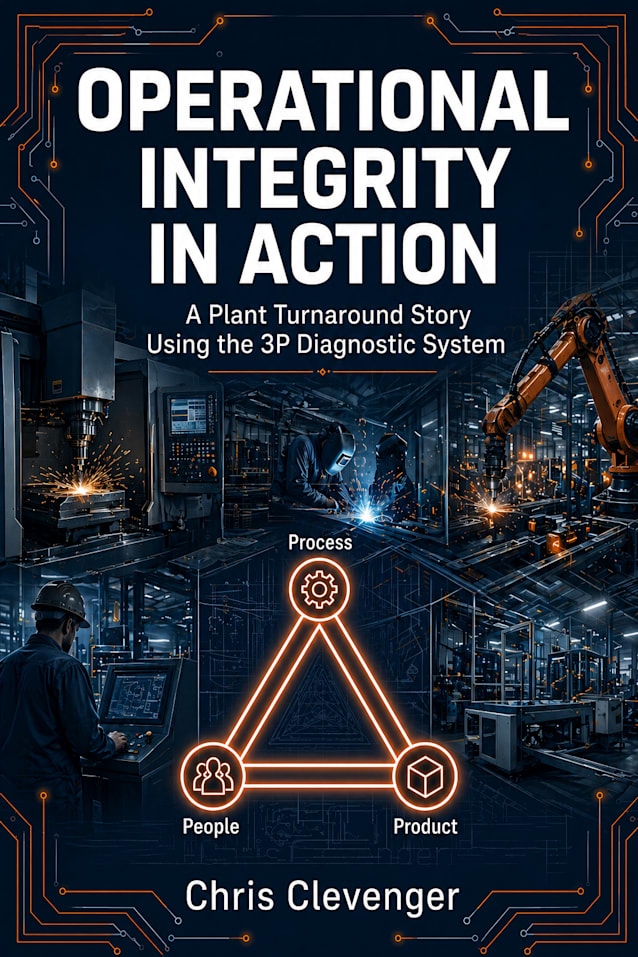
Operational Integrity in Action: A Plant Turnaround Story Using the 3P Diagnostic System brings manufacturing leadership, operational excellence, and plant turnaround strategy to life through a realistic story set inside a struggling industrial operation.
Ridgeway Trailer Manufacturing is busy—but it is not stable.
Safety risks have become routine. Quality problems are discovered too late. Rework is accepted as normal. Production schedules change constantly. Departments blame one another. Experienced employees compensate for weak processes. Supervisors spend their days reacting to problems instead of preventing them. Morale is declining, labor utilization is poor, and the plant is losing confidence in its own ability to improve.
Then Daniel Mercer arrives as the new Plant Manager.
Daniel does not walk into Ridgeway with a ready-made turnaround plan or a list of quick fixes. He starts by observing the operation, walking the shop floor, listening to employees, reviewing the numbers, and asking a harder question:
What allows these same problems to keep happening?
That question becomes the beginning of Ridgeway’s transformation.
As Daniel studies Operational Integrity Code, he begins applying its 3P Diagnostic System: People → Process → Product to the real conditions inside the plant. What initially looks like a collection of unrelated problems begins to reveal a much larger pattern.
Unsafe behavior is not just a safety problem.
Rework is not just a quality problem.
Waiting is not just a labor problem.
Schedule failure is not just a planning problem.
Low morale is not just a people problem.
Each condition is connected to the operating system around it.
Daniel begins identifying Hidden Failure Nodes—small structural weaknesses buried inside normal manufacturing work that allow instability to repeat. These failure nodes appear in machine shop handoffs, fabrication rework, assembly delays, production scheduling, quality inspection, maintenance response, leadership behavior, and the daily decisions employees make to keep production moving.
The plant and characters in Operational Integrity in Action are fictional.
The manufacturing conditions are not.
This book was written for plant managers, manufacturing leaders, operations managers, production supervisors, quality professionals, safety leaders, maintenance managers, engineers, continuous improvement teams, and executives responsible for plant performance.
Readers follow Daniel and the Ridgeway leadership team as they move from operational firefighting toward structural diagnosis.
Along the way, the story explores major manufacturing leadership challenges including:
- Recurring safety exposure and normalized risk
- Quality defects and late inspection
- Rework and scrap
- Poor labor utilization
- Production scheduling instability
- Weak departmental handoffs
- Tribal knowledge and employee dependency
- Process variation between shifts
- Equipment and maintenance problems
- Employee frustration and declining morale
- Leadership accountability
- Workaround culture
- Manufacturing productivity
- Plant turnaround strategy
- Operational discipline
- Sustainable continuous improvement
At the center of the story is the Operational Integrity Interface (OII) and its disciplined approach to identifying what is actually happening inside the manufacturing system.
Daniel first learns to detect failure nodes.
Then he examines how people are adapting to unstable processes.
He begins tracing how those process weaknesses affect product quality, safety, workflow, labor, and schedule performance.
Only after the real mechanisms become visible does the plant begin changing its structure.
That distinction is important.
Operational Integrity in Action is not a story about pushing employees harder.
It is a story about building a manufacturing system that no longer requires employees to constantly compensate for instability.
Throughout the turnaround, Daniel follows one of the central principles of the Operational Integrity philosophy:
Safety First → Quality Second → Productivity Last
The plant does not chase productivity first.
Safety must become stable.
Quality must move closer to the source.
Processes must become executable under real manufacturing conditions.
Handoffs must become clearer.
Leadership standards must become consistent.
Only then can sustainable productivity grow.
This approach challenges a common manufacturing problem: plants that appear productive because everyone is busy, while large amounts of labor and capacity are actually being consumed by rework, waiting, expediting, material shortages, unclear decisions, inspection, downtime, and constant recovery.
Operational Integrity in Action shows what happens when a leader begins separating activity from productivity and explanation from diagnosis.
Daniel also confronts the plant’s Reality Filter—the collection of explanations organizations use to make recurring failure seem normal.
“It’s an operator issue.”
“It’s maintenance.”
“It’s scheduling.”
“It’s a supplier problem.”
“That’s just manufacturing.”
These explanations may contain some truth. But when the same problems continue returning, they are not enough.
Daniel pushes the team to stop asking only:
“Who caused this?”
and begin asking:
“What condition in the system allows this to repeat?”
That shift changes the way Ridgeway sees safety, quality, people, production, maintenance, scheduling, accountability, and leadership itself.
The book also shows the practical side of manufacturing culture change.
Daniel builds leadership visibility through regular Gemba walks and direct interaction with employees across shifts. He works to rebuild trust, strengthen accountability, address toxic behavior, reduce dependence on individual heroics, and create an environment where problems can be identified earlier.
But the story does not treat culture as a slogan.
Culture improves as the operating system improves.
When employees spend less time fighting broken processes, waiting for information, correcting bad parts, working around equipment problems, and responding to changing priorities, the plant begins becoming more predictable.
That predictability changes morale.
It changes leadership behavior.
It changes quality.
It changes productivity.
And eventually, it changes what employees believe is possible.
Operational Integrity in Action is the narrative companion to Operational Integrity Code: The 3P Diagnostic System for Eliminating Hidden Failure and Restoring Safety, Quality, and Productivity in Manufacturing. While Operational Integrity Code establishes the doctrine, diagnostic structure, Hidden Failure Nodes, Reality Filter, Structural Recode, and Operational Integrity Interface, this book places those principles inside a living manufacturing environment and shows how they can influence the decisions of a plant leadership team under real operating pressure.
The story follows Daniel as Ridgeway moves from a plant defined by recurring safety exposure, rework, schedule disruption, low labor utilization, weak morale, and departmental frustration toward an operation built around greater stability, accountability, process discipline, quality at the source, and operational control.
For readers interested in manufacturing leadership, operational excellence, plant management, Lean manufacturing, continuous improvement, plant turnaround, quality management, workplace safety, manufacturing productivity, process improvement, root cause analysis, workforce accountability, and manufacturing culture, Operational Integrity in Action provides something different:
A chance to see the system working inside the plant.
Not as theory.
Not as a presentation.
As leadership decisions made under pressure.
Because the strongest manufacturing operations are not built by constantly recovering from failure. They are built by removing the conditions that keep creating it.